Sales Order To Work Orders is the workspace where production planners turn open customer demand into Work Orders. It lists every Sales Order line and every Reserved Accounts Receivable Invoice line that still needs production, lets the planner type the quantity to make for each line, and creates the corresponding Work Orders in one click — individually, as a single collective Work Order, or merged through the Beas merge phantom.
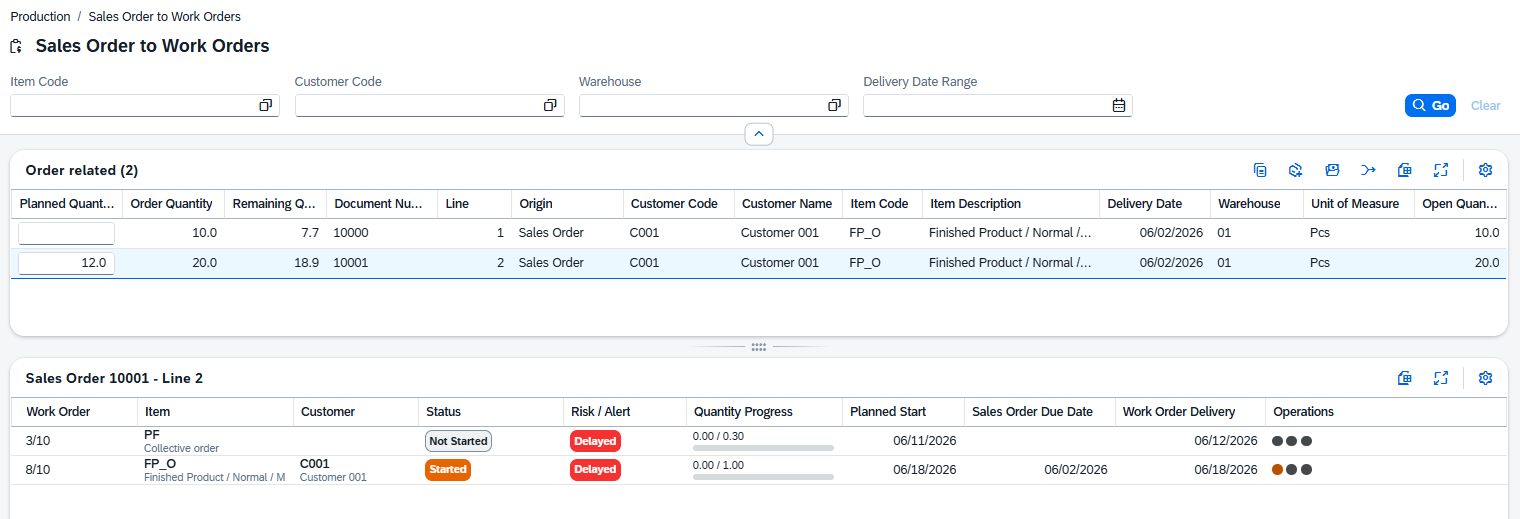
Accessing the view:
The view can be found in the Beas Web Client analytics area and is opened from the launchpad.
Direct URL: /views/so-to-po
Filters
The header filter bar narrows the Order-related table. Press Go to apply; the active filter set is reflected in the page URL so the same view can be shared as a link.
Filter |
Description |
|---|---|
Item Code |
Multi-select item selector. Returns rows whose item appears in the chosen list. |
Customer Code |
Customer selector. Restricted to customers — leads and suppliers cannot be selected here. |
Warehouse |
Limits the result to lines posted on the selected specific warehouse(s). |
Delivery Date Range |
From / To date filter applied to the line's Delivery date. |
IMPORTANT: The two tables described below display both open and closed Work Orders.
Order-related table
The Order-related table lists, in a single grid, two kinds of open document lines:
Sales Order lines — open lines from confirmed sales orders.
Accounts Receivable Invoice lines — open lines from Reserved A/R Invoices (invoices that commit inventory but defer the stock movement). Regular A/R Invoices already moved stock at posting and do not appear here. The Source column distinguishes both kinds. Both are operated on with the same actions. Columns marked (not visible) are not shown by default and can be enabled from the column settings.

|
Toolbar actions
The toolbar above the Order-related table exposes four actions, in increasing order of consolidation.
Action |
Icon |
Behavior |
|---|---|---|
Pre-Assign |
|
Fills Target Quantity with Remaining Quantity on every row currently visible in the table. Re-clicking re-applies the Remaining Quantity even if the planner had typed a different value, so it can also be used to discard pending edits. |
Create Work Order |
|
Creates one Work Order for every row with Target Quantity > 0. Each Work Order is linked back to its source line. If one line fails, the others still go through and a summary toast reports successes and failures. |
Create Collective Order |
|
Creates a single Work Order with one position per selected line. Use it when several lines should share the same Work Order header but stay traceable as separate positions. The action is all-or-nothing — if any line fails, no Work Order is created. |
Merge Work Orders |
|
Creates a single Work Order whose header item is the merge phantom configured in Beas. Components are the union of the selected items' bills of materials, with shared components summed. Example: two finished products needing 2 + 3 of the same raw material produce a merged order with 5 of that raw material. The original lines stay traceable as merge sources. The action requires every selected line to have a warehouse — if none of the selected lines has one, the action is rejected with an inline error. |


Quick planning of a backlog: apply Pre-Assign, then Create Work Order — every backlog line becomes a Work Order in one step.
Related Work Orders: When a row is selected in the Order related table, the Related Work Orders table lists every Work Order linked to that line — regardless of whether the source is a Sales Order or an Accounts Receivable Invoice. Both kinds of links are surfaced: Work Orders created directly from this line through Create Work Order or Create Collective Order. Merged Work Orders into which this line was rolled through Merge Work Orders. The merge phantom Work Order is shown so the planner can follow up on production even if the line is not the header of the merged order. The table is read-only. Its title shows the selected document and line.
Example:
Sales Order 20250065 - Line 1 or Accounts Receivable Invoice 7 - Line 1. Columns Columns marked (not visible) are not shown by default and can be enabled from the column settings.
Sales Order table
Column |
Description |
|---|---|
Work Order |
Work Order ID and position (two-line cell). |
Item |
Item code and description being produced by the Work Order. |
Customer |
Customer code and name the Work Order is allocated to. |
Status |
Production status: Closed, Completed, In Progress, Started, Not Started. The column filter renders as a combo box of these values. |
Risk / Alert |
Risk tags such as Delayed, Delay Alert, Quantity Risk or Blocked. |
Quantity Progress |
Visual progress bar comparing Actual Quantity to Planned Quantity, with the unit of measure as a suffix. |
Planned Start |
Date the Work Order is scheduled to start. |
Sales Order Due Date |
Promised due date of the source Sales Order line. |
Work Order Delivery |
Delivery date of the Work Order itself. |
Operations |
Per-operation progression dots; hover for the operation detail. |
Sales Order (not default) |
Sales Order number and line. Hidden by default because the same information appears in the table title. |
Planned Quantity (not default) |
Planned quantity to produce on this Work Order. |
Actual Quantity (not default) |
Quantity already produced on this Work Order. |
Closed (not default) |
Check box indicating whether the Work Order is closed. |
Tips
Save raw material picks: when several lines share components, prefer Merge Production Orders so the shared materials are picked once. Spot orphans: click a row and watch the Related Production Orders table — if the Remaining Quantity is positive but the table lists Work Orders, those Work Orders may be partial and need a follow-up. Personalize columns: open the column settings to bring On Hand, On Order, Committed and Order On Hand into the Order related table for a stock-aware view.